Success message
Error message

are my very favorite, but my second favorite color for flowers is yellow. Yellow symbolizes sunshine, happiness and light. Many of the wildflowers have already turned their energy toward seed production (in the fall) but not all. And there may be some still in bloom in the higher elevations on some of the area’s many hiking trails but I don’t know for sure because I haven’t yet had time for a hike!
I’m not an expert on flower identification but I’ll do my best here. It’s important to have a wildflower field guide handy. I have several but two I refer to all the time are Tahoe Wildflowers – A Month-by-Month Guide and Sierra Nevada Wildflowers; both are Falcon Guides.
With the advancements of the smart phone, identifying what you see has become much easier. Two indispensable apps are: iNaturalist and MerlinBirdID.
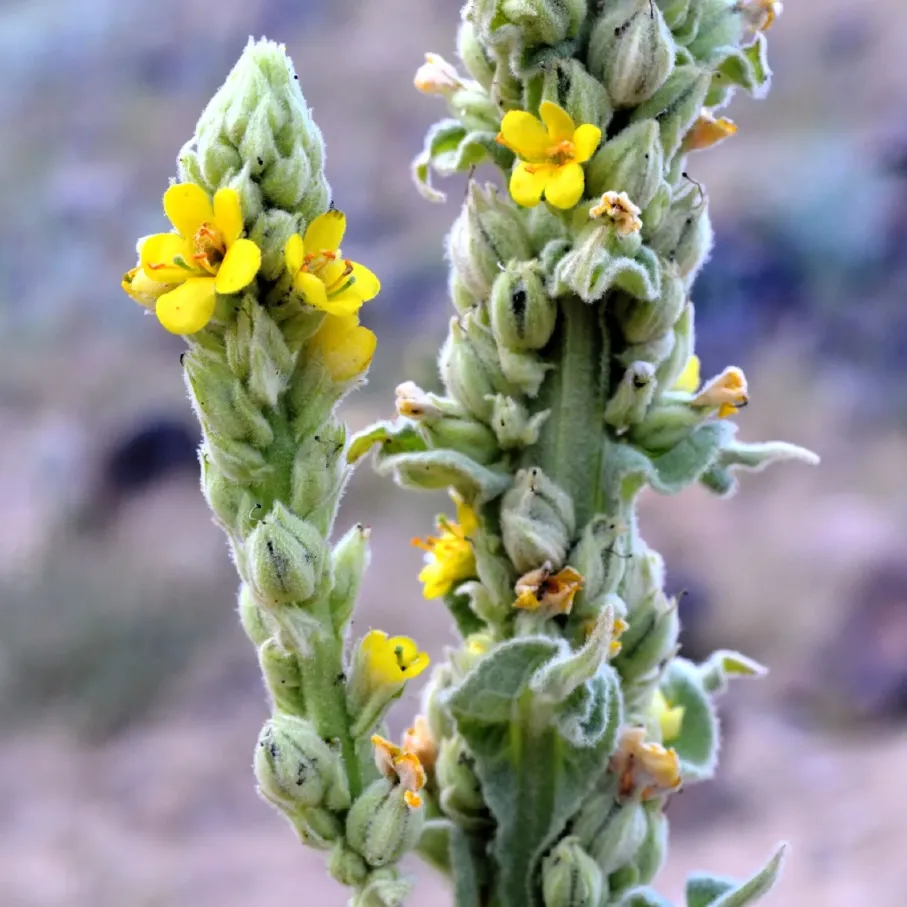
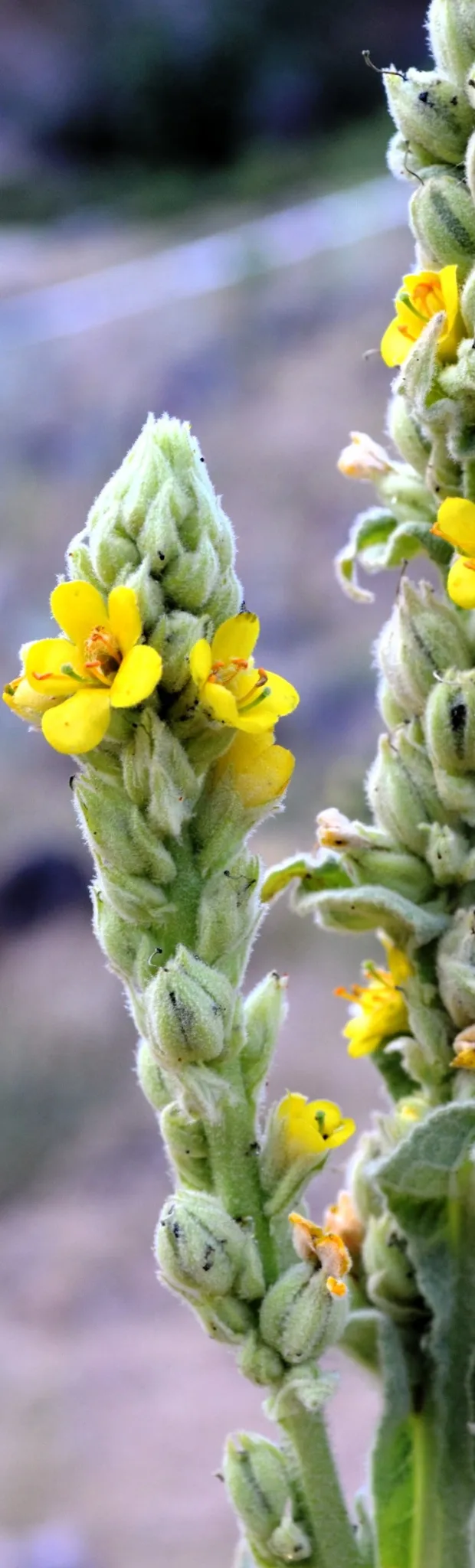
A tall, thin plant, appearing as a spike on the landscape is the woolly mullein. This is a non-native species found in disturbed areas, along roadways and streams. To appreciate its beauty, you’ll need to get close to view the five-petal flowers that pop open along the top of its stem.
This is a biennial plant. The first year it produces a rosette of large, woolly leaves. The second year the leaves are less abundant and it sends up a single, unbranched stem, 6 or 7 feet tall. Flowering begins at the bottom of the stem with flowers opening irregularly along it for about three months, until the top of the stem is blooming. Each flower is only open for one day, basking in full sun.
The mullein is used as a remedy for skin, throat and breathing ailments and as an astringent. If making tea from the leaves, it’s important to finely filter it, to eliminate the irritating hairs.
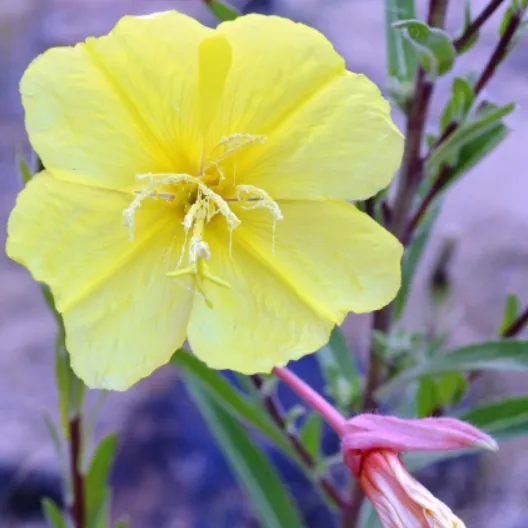
Another plant whose flower is only open for a day is the evening primrose. There are several specimens of what I believe to be the common evening primrose along the path I take nearly every day with the dogs.
Also a biennial, the pale yellow flowers on this plant open very quickly in the evening and last until about noon the next day.
The blooms are one to two-inch, bi-lobed petals, opening to reveal wispy stamens. The interior of this stunning flower contains a nectar guide pattern that attracts pollinators but is only visible to us mere humans under ultraviolet light.
Several Native American tribes used this plant for food. The roots can be boiled, the leaves cooked and served as greens or steeped as tea.
The primrose is cultivated for its oil which contains essential fatty acids (meaning the body cannot synthesize it from other food sources).
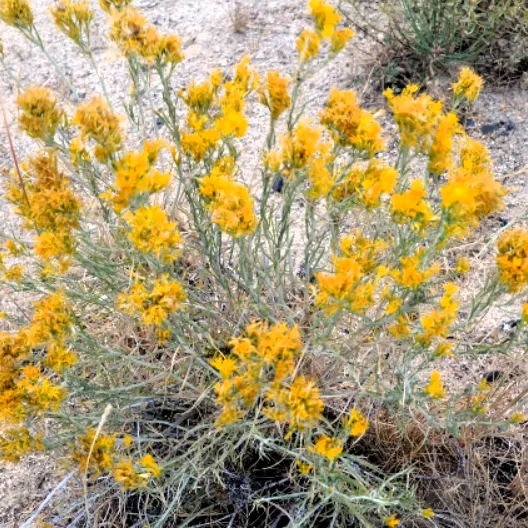
If you’re an avid wildflower seeker, do not despair. The woolly mullein is winding down but the evening primrose is still putting on a show and another September bloomer that is just now bursting into its glory is the rabbitbrush.
This sometimes large dense shrub can be used as cover for small animals and is a member of the sunflower family.
The flower heads are clustered atop grayish-green stems with long, linear leaves occurring regularly along the stem. Find it in open areas in full sun. The flower heads can be used to produce dyes.
Probably the best way to see fall flowers is on a hike, September and October being an excellent time to do so, given the cooler days. Even though most of the wildflower’s blooms are spent, they are still interesting. Teach yourself to look for the drying flowers and remember that the plant is still working, producing seed or gathering food from the sun to sustain it over the winter.
Toree Warfield is an avid nature lover, and writes this column to teach and stimulate interest in the marvels that surround us.
http://www.nrcs.usda.gov/Internet/FSE_PLANTMATERIALS/publications/wapmcpg3530.pdf
http://en.wikipedia.org/wiki/Chrysothamnus
http://plants.usda.gov/java/largeImage?imageID=basa3_013_ahp.tif
http://calphotos.berkeley.edu/cgi/img_query?enlarge=8076+3101+3985+0092
http://plants.usda.gov/java/largeImage?imageID=oebi_3v.jpg
http://en.wikipedia.org/wiki/Ericameria
http://en.wikipedia.org/wiki/Senecio_triangularis
http://en.wikipedia.org/wiki/Verbascum_thapsus
http://uswildflowers.com/detail.php?SName=Oenothera%20biennis
http://en.wikipedia.org/wiki/Oenothera_biennis
http://en.wikipedia.org/wiki/Nectar_guide
