Success message
Error message

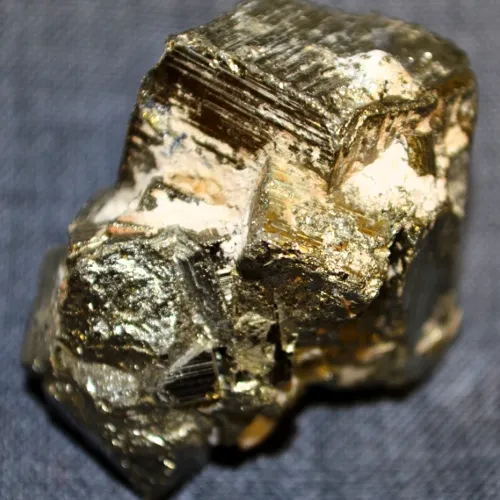
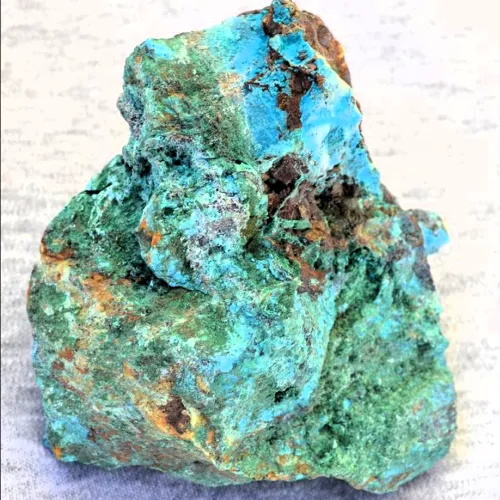
attending the farmer's market to score fresh produce, and I have at times been a vendor myself. It was at one of these that I met Dave, the Rock Man, who was there peddling rocks.
I happened to set up next to him and when we finally had a moment to chat, I took in his array of cool rocks and had to tell him how much I love rocks and that I used to scour the ground for agates as a child. Dave became enamored with rocks as a child also and now makes a living prospecting for rocks, which entails much more than looking for rocks on the ground—to find the good stuff, one must be willing to dig.
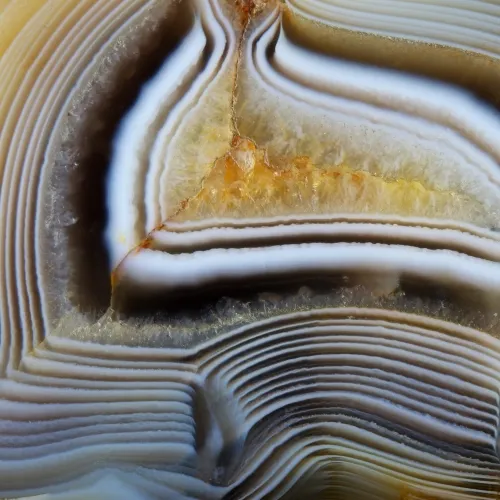
Agate is the name of a group of silicate minerals that are made up primarily of chalcedony, a member of the quartz family, and is formed in cavities of volcanic rock. Silica-rich water percolates through the rocks, depositing layers of mineral. Slight differences in the mineral composition cause the multi-colored banding. Sometimes the cavity does not fill completely, and larger crystals form on the interior, giving us the geode.
In researching for this column, I learned why agates are so plentiful in Minnesota where I grew up. They originated about one billion years ago when the North American continent began to split, creating a large rift valley, setting the stage for Lake Superior. Lava welled up, trapping gasses as it cooled. The gasses escaped when the magma began to solidify, leaving behind pockets where agates could form. Glaciers eventually deposited these beautiful specimens throughout the state.
In the Sierra, the four main types of rock are granite, volcanic, sedimentary and metamorphic. All these types of rocks are formed from minerals, most of which are silicates that contain various proportions of the elements sodium, potassium, aluminum, calcium, iron and magnesium.
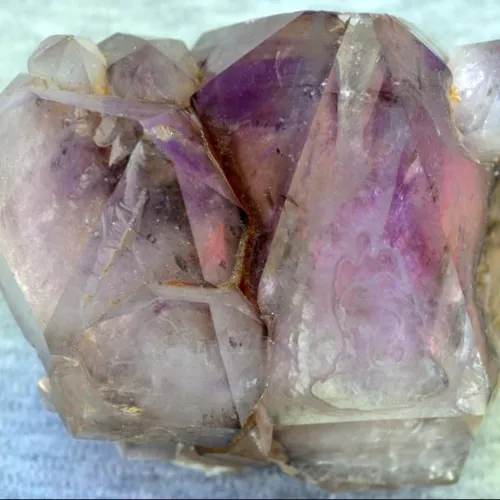
Quartz is the second most abundant mineral in the earth’s crust, and is an important constituent in many rocks. One of my favorites is amethyst, the purple variety of quartz. The purple color comes from iron impurities in the crystalline structure, stimulated by the low doses of radiation present in rock. If the gem is heated, the oxygen is removed from the iron and the purple color fades. In fact, the yellow gemstone, citrine, is manufactured by heating lesser-quality amethysts.
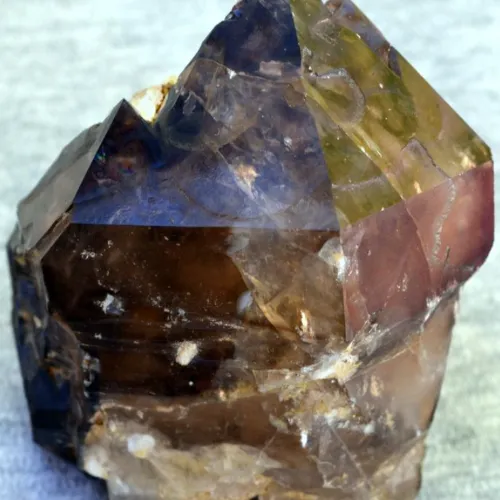
Another attractive rock is the smoky quartz, which is a brown variety of quartz, typically found in granite. The smoky color is caused by aluminum impurities, slightly irradiated by the naturally-occurring radiation emanating from the granite.
Dave has a selection of these and other quartz varieties bu tone he is really proud of is the “Angel Amethyst”, found on a routine dig. It wasn’t until several days later, when he was cleaning and polishing it before a show, that he noticed the etching in the shape of an angel on one facet of this unique purple crystal.
Dave scouts for these rocks in the Peterson Mountains, near Hallelujah Junction, northwest of Reno using a hammer and chisel. He also goes underground in his search for rocks, which he does not recommend for the average person as it can be very dangerous. In addition, he cuts and polishes his finds, creating jewelry and display pieces.
You can dig for gemstones in Nevada at public sites like Garnet Hill (for garnets) and the Black Rock Desert (for geodes), or at commercial pay-to-dig mines in the Virgin Valley (for world-famous fire opal) and the Royston Turquoise Mine (for turquoise), with options ranging from free surface collecting to fee-based deep digging for various gems and minerals like agate, jasper, and wonderstone.
Now that sounds like my kind of excursion! Who knows what you might find.
Toree Warfield is an avid nature lover, and writes this column to teach and stimulate interest in the marvels that surround us.