Success message
Error message

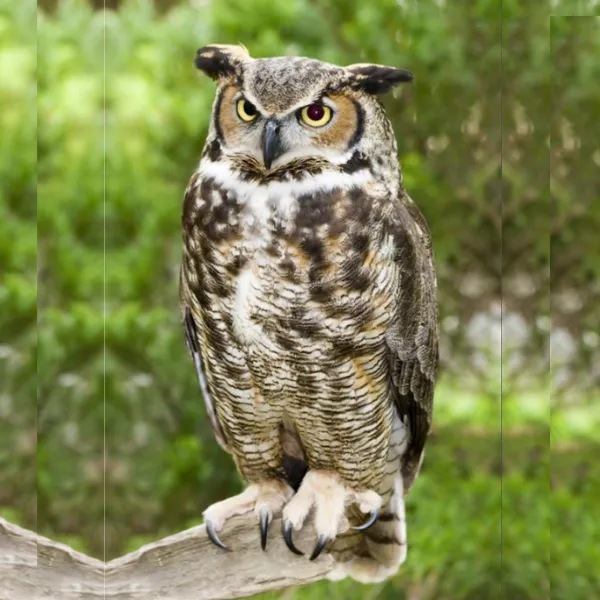
bird of prey that can be found in this area is the owl. A great horned owl flew in front of my house one time in the middle of the day, landing in my neighbor’s tree where he perched for a short time, swiveling his head. I think he was looking for the part of a mouse I found in my driveway a short time later! An owl can turn his head up to 270 degrees, right or left, from the front-facing position.
The great horned owl is the most common owl in North and South America and has adapted itself to almost a complete range of habitat. Different subspecies of this owl have been named—the one I saw was probably a California great horned owl which is dark brown, with a tawny brown face and glowing yellow or orange eyes. All subspecies have pointed, ear-like tufts on their heads. He’s a large owl—about two feet long, weighing about three pounds with up to a five-foot wing span. Compare this figure to the 3 ounces of the Northern Saw-whet owl, whom we shall meet in a moment.
The perfect territory for this owl will include a forested or secluded area for nesting, with a nearby open area for hunting. They hunt mostly small to medium-sized mammals but will also prey upon porcupines and skunks. As with all owls, great horned owls have an incredible digestive system which allows them to eat small prey whole, later regurgitating pellets of bone and fur.
They breed in late January or early February and this is another bird that mates for life. They don’t waste time building a nest; rather they adopt a tree hole, hollow stump or small cave and perhaps add a few feathers where they lay usually two eggs.
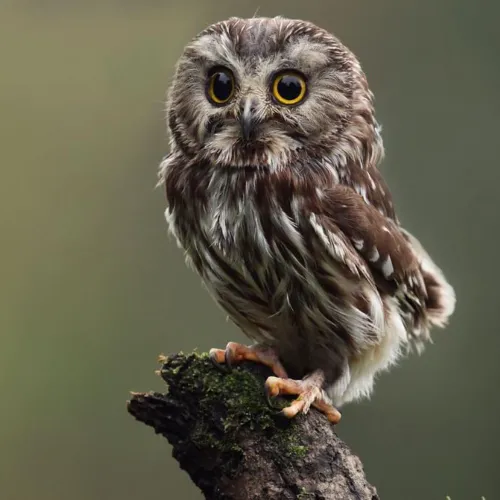
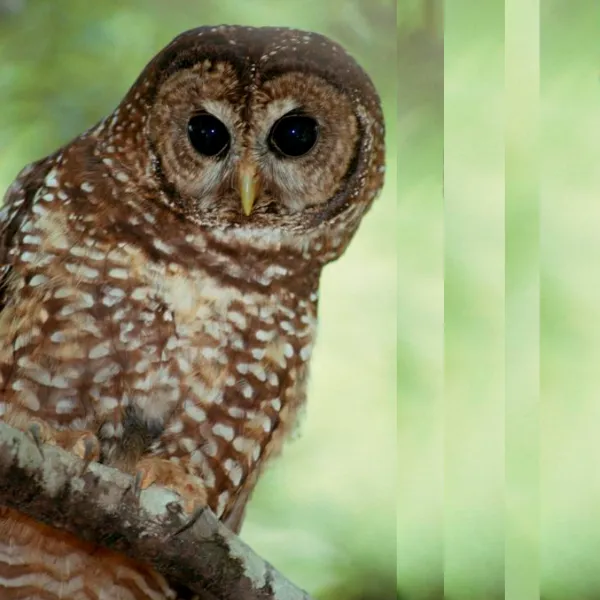
Two other beautiful area owls I’ve never been lucky enough to see but I found someone who has, are the California spotted owl and the Northern Saw-whet Owl. South Shore photographer Jon Paul, jonpaulgallery.com, was out early one morning looking to “shoot bear”—on film, of course. What he found instead was a pair of baby Northern Saw-whet owls, peering at him from a tree branch. To see the photos he captured that day, be sure to visit his gallery on-line.
Northern Saw-whet owls are a member of the “small owl club”, which includes the pygmy and elf owls. He’s about the size of an American robin, around 7” long and weighs on average about 3 ounces. Owls and other birds have hollow bones, reducing their weight in relation to their size.
To see or hear this small owl, you’ll need to be out late in the evening or very early in the morning, as he’s strictly nocturnal. He sings a song of monotonous, tooting whistles only in late winter and early spring.
The California Spotted Owl likes older growth forests in part because they like the moist conditions present in dense forest canopies. This population is currently on the decline, and recently was voted by the California Fish and Game Commission to become a candidate for listing under the California Endangered Species Act.
Even while the California Fish and Game Commission voted to protect this owl, the U.S. Fish and Wildlife Service and the National Marine Fisheries Service approved a plan that would allow Fruit Growers Supply Co. accelerated logging of occupied spotted owl habitat in California’s old growth forests.
Fruit Growers Supply Company (FGS) operates under a 50-year Multi-Species Habitat Conservation Plan (HCP), approved in 2012, encompassing approximately 150,000 acres in Northern California.
The plan allows logging that may impact the threatened Northern Spotted Owl in exchange for long-term habitat management and mitigation. I guess we just have to hope that our elected officials have made the right choice.
Jon was lucky, indeed, to spot this beautiful owl. Be sure to see all his pictures at jonpaulgallery.com.
Toree Warfield is an avid nature lover, and writes this column to teach and stimulate interest in the marvels that surround us.

Sources:
http://www.jonpaulgallery.com/index.php#mi=2&pt=1&pi=10000&s=10&p=4&a=0&at=0
http://www.owlpages.com/news.php?article=431
http://www.tahoeculture.com/outside/lake-tahoe-birding/the-magical-sounds-of-tahoe-birds/
http://www.redrockaudubon.org/nv-bird-feed/nv-birds/northern-pygmy-owl-at-lake-tahoe/
http://birds.audubon.org/birds/northern-pygmy-owl
http://www.tahoedailytribune.com/article/20060712/NEWS/107120024
http://www.allaboutbirds.org/guide/Red-Tailed_Hawk/id
http://en.wikipedia.org/wiki/Red-tailed_Hawk
http://animals.nationalgeographic.com/animals/birds/red-tailed-hawk/
http://birds.audubon.org/birds/red-tailed-hawk
http://www.fcps.edu/islandcreekes/ecology/red-tailed_hawk.htmhttp://www.owlpages.com/owls.php?genus=Aegolius&species=acadicus
http://en.wikipedia.org/wiki/Northern_Saw-whet_Owl
http://www.allaboutbirds.org/guide/Northern_Saw-whet_Owl/id
http://birds.audubon.org/birds/northern-saw-whet-owl
http://www.owlpages.com/articles.php?section=owl+physiology&title=Skeleton
http://www.care2.com/causes/loggers-get-the-ok-to-kill-endangered-spotted-owls.html
http://www.sierraforestlegacy.org/FC_SierraNevadaWildlifeRisk/CaliforniaSpottedOwl.php
http://www.care2.com/causes/loggers-get-the-ok-to-kill-endangered-spotted-owls.html
http://www.biologicaldiversity.org/species/birds/northern_spotted_owl/pdfs/FGS_HCP_Complaint.pdf